Perched 370 metres above the sea on the ridge of Mesa Vouno, Ancient Thera is an archaeological site spanning Dorian, Hellenistic, Roman, and Byzantine periods. The panoramic views of both Kamari and Perissa below make it one of Santorini's most rewarding half-hours of effort.
In this guide
Ancient Thera doesn't get the attention that Akrotiri does. Akrotiri is older, better preserved, and more dramatic. But Ancient Thera has something Akrotiri lacks: the setting. The ruins sit along a narrow ridge between two sheer drops, with the Aegean stretching to the horizon on both sides. On a clear day you can see Ios, Naxos, and Paros.
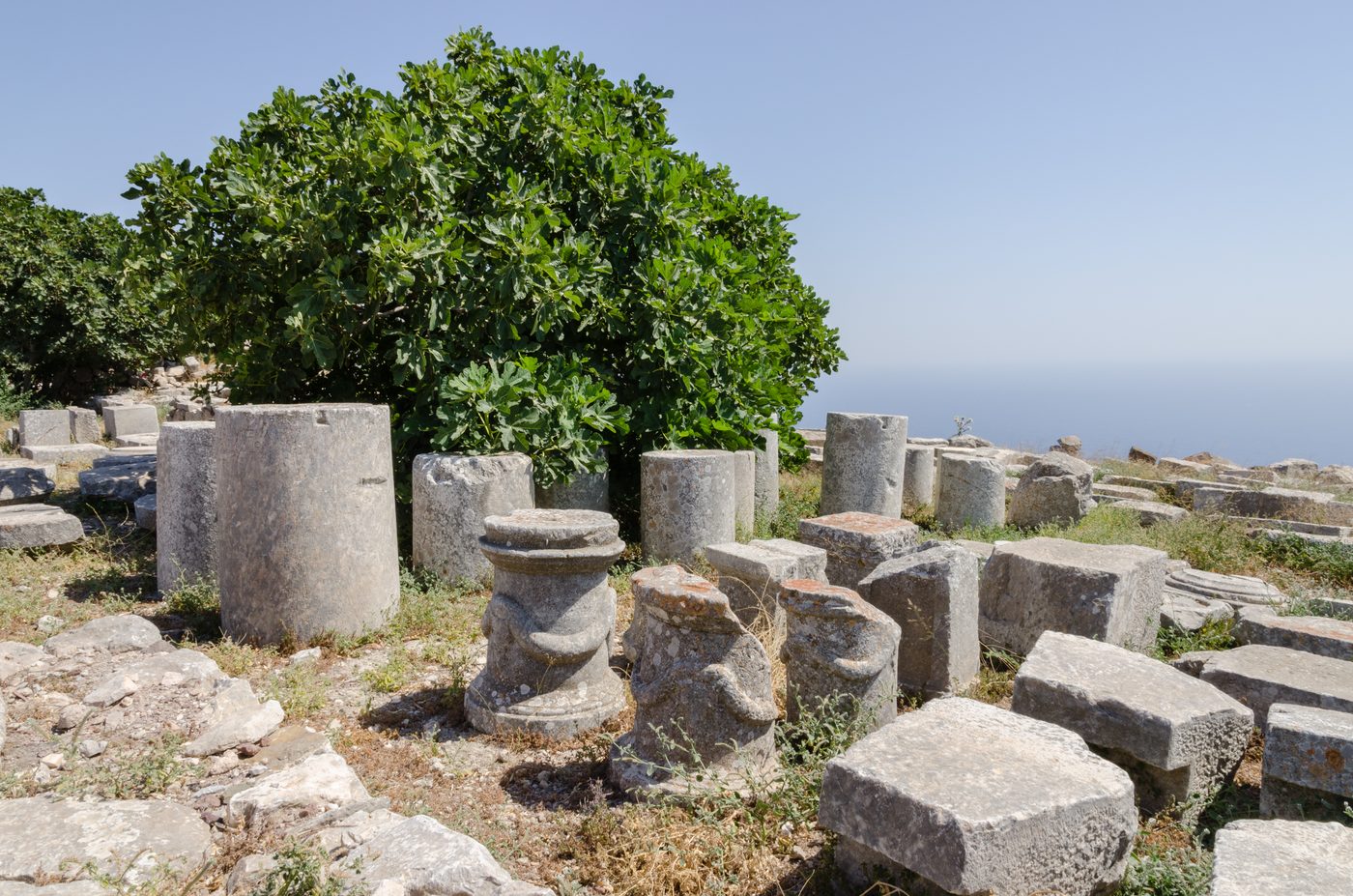
The city was founded by Dorian Greeks in the 9th century BC and continued to be occupied through the Hellenistic, Roman, and Byzantine periods. What remains is a mixture of temple foundations, a theatre, a military gymnasium (the Gymnasium of the Epheboi), residential quarters, and carved inscriptions, all scattered along the ridge in a setting that makes even modest ruins feel significant.
How Do You Get There?
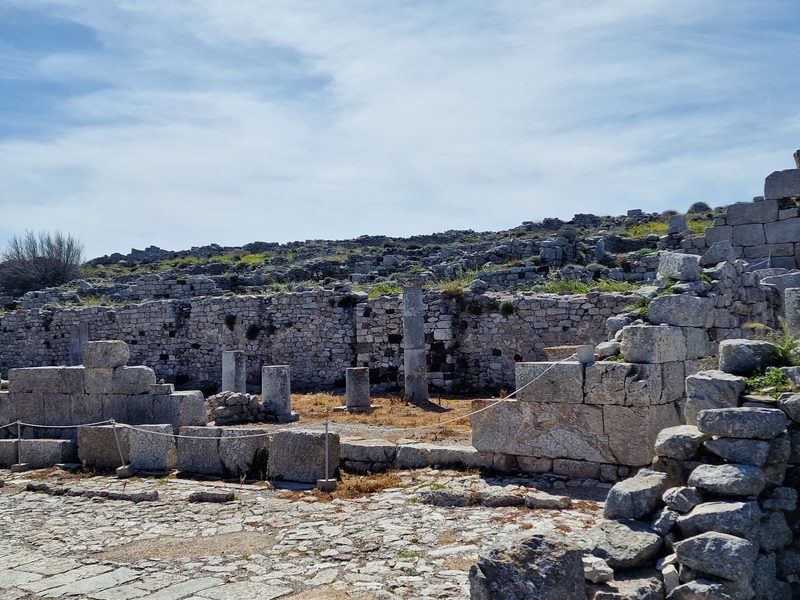
Ancient Thera sits on top of Mesa Vouno, the mountain between Kamari and Perissa. There are two access routes:
From Kamari (Most Common)
A steep, winding road (pedestrians and minibuses only) leads up from the Kamari end. A minibus runs from the base of the road to the site entrance; check locally for schedules and price (a few euros each way). Walking up takes about 45 minutes. It is steep but manageable.
From Perissa
A hiking trail goes up from the Perissa end, which is steeper and less maintained than the Kamari road but shorter. Allow 30-40 minutes for the ascent. This route has better views on the way up but is harder on the knees.
By Car or ATV
You can drive part of the way up the Kamari road, but vehicle access to the top is restricted. The road is narrow and ends at a barrier; from there you walk the final stretch.
| Detail | Info |
|---|---|
| From Fira | Bus to Kamari (15 minutes, 2.20 EUR), then walk or minibus up |
| Walking time | 30-45 minutes uphill from either base |
| Difficulty | Moderate. Steep in places, fully exposed to the sun. |
Take the Kamari route up and the Perissa trail down (or vice versa). You end up at a different beach than you started, and the boat between Kamari and Perissa gets you back to your starting point. It makes for a satisfying loop.
What Will You See?
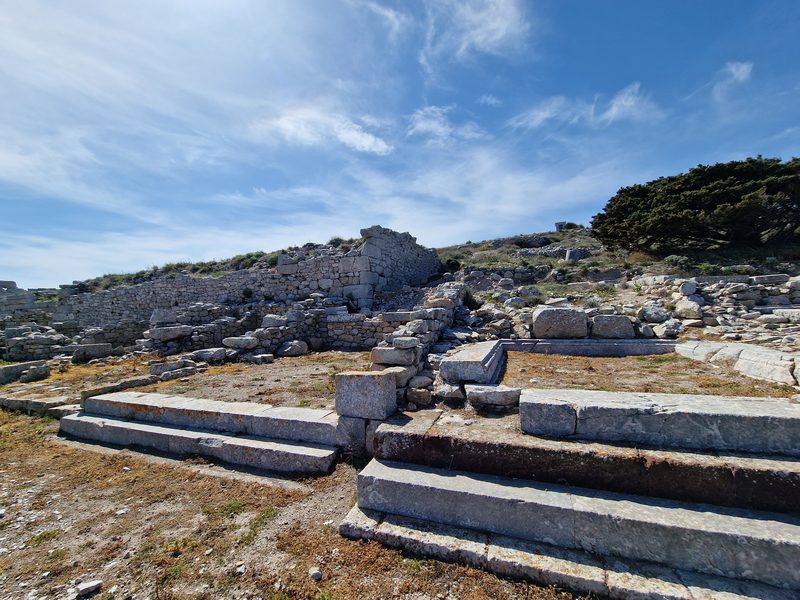
The site is laid out along the ridge, so you walk from one end to the other rather than exploring a compact area. Information boards explain the main structures.
The Agora and Stoa
The commercial and social centre of the ancient city. The Stoa (colonnade) would have been where citizens gathered, traded, and argued about politics. Only the foundations remain, but the scale is clear.
The Theatre
A small semicircular theatre cut into the hillside, facing the sea. It seated a few hundred people and is still recognisable as a performance space. From the upper rows you look straight down the hillside to the sea.
Temple of Apollo Karneios
One of the best-preserved structures on the site. Apollo Karneios was a patron deity of Dorian Greeks, and this temple was central to the city's religious life. Look for carved inscriptions on nearby rocks. Some are graffiti from ancient soldiers.
Gymnasium of the Epheboi
Where young men trained in athletics and military skills. The carved inscriptions here include some of the most interesting on the site: dedications, names, and even what appear to be declarations of love between soldiers.
The Terrace of Celebrations
A flat area used for festivals and ceremonies, with views in every direction. This is the best spot for photos.
What Should You Know Before Going?
- Entry fee: 10 EUR (full), 5 EUR (reduced). Buy online at tickets.hh.gr to pay by card — bring cash for the gate.
- Opening hours: 08:30-15:30, closed Wednesdays. Last admission at 15:00.
- Allow 1-2 hours for the site itself, plus 45 minutes each way for the walk.
- There is no shade on the path or at the site. This matters more than you think. In July-August, the walk up in midday sun is punishing. Go early or late.
- Bring water. At least a litre. There's nothing to buy at the top.
- Wear proper shoes. The path is steep and loose in places. The site itself is uneven rocky ground.
- Start early. The site closes at 15:30, but the real reason to go early is the heat and the light. Morning light on the ruins with the sea below is the best.
- Combine with a beach day. Walk up from Kamari in the morning, explore the ruins, walk down to Perissa, and spend the afternoon on the beach.
When Is the Best Time to Visit?
May-June and September-October. The walk up is manageable and the ruins are at their most atmospheric in the warm, clear light.
July-August. Go at opening time (08:30). By 10:30 the path is an oven and the stone reflects heat back at you. Not recommended in the afternoon.
April and November. Cooler, quieter, but check that the site is open (winter hours may differ).
The site is closed on Wednesdays year-round.
Ancient Thera is on Mesa Vouno between Kamari and Perissa. Entry 10 EUR. Open 08:30-15:30, closed Wednesdays; from November opening is limited, and December-February is by appointment only. Allow 2-3 hours including the walk up.
Planning more adventures on the island? Browse our complete guide to the best day trips from Santorini.
Last updated: